

Last week I travelled to London’s Southbank Centre for the D&AD President’s Lectures. Tackling the theme of ‘Dead or Alive’, there were talks from a variety of perspectives across the creative industries, all championing that creativity is very much alive and kicking, For me, the day’s standout talks had a brand focus. Agency founder Alex Center spoke about his career through a history of brands, from those he loved as a teenager to the ones he builds now. Court Williams, VP of Creative Strategy at DE-YAN, talked about immersive brand experiences and the connection between digital and design. And graphic designer Stefan Sagmeister closed the event with a trip back to the nineties full of rock music, design and legal troubles. Last year’s event inspired me to set up the Accord Studio Cultural Calendar and pen an ode to curiosity. This year I came away with a chaotic Instagram search history, a long list of notes, and a burning desire to write it all down for you, so strap in.
Last week I travelled to London’s Southbank Centre for the D&AD President’s Lectures. Tackling the theme of ‘Dead or Alive’, there were talks from a variety of perspectives across the creative industries, all championing that creativity is very much alive and kicking, For me, the day’s standout talks had a brand focus. Agency founder Alex Center spoke about his career through a history of brands, from those he loved as a teenager to the ones he builds now. Court Williams, VP of Creative Strategy at DE-YAN, talked about immersive brand experiences and the connection between digital and design. And graphic designer Stefan Sagmeister closed the event with a trip back to the nineties full of rock music, design and legal troubles. Last year’s event inspired me to set up the Accord Studio Cultural Calendar and pen an ode to curiosity. This year I came away with a chaotic Instagram search history, a long list of notes, and a burning desire to write it all down for you, so strap in.
Last week I travelled to London’s Southbank Centre for the D&AD President’s Lectures. Tackling the theme of ‘Dead or Alive’, there were talks from a variety of perspectives across the creative industries, all championing that creativity is very much alive and kicking, For me, the day’s standout talks had a brand focus. Agency founder Alex Center spoke about his career through a history of brands, from those he loved as a teenager to the ones he builds now. Court Williams, VP of Creative Strategy at DE-YAN, talked about immersive brand experiences and the connection between digital and design. And graphic designer Stefan Sagmeister closed the event with a trip back to the nineties full of rock music, design and legal troubles. Last year’s event inspired me to set up the Accord Studio Cultural Calendar and pen an ode to curiosity. This year I came away with a chaotic Instagram search history, a long list of notes, and a burning desire to write it all down for you, so strap in.
A life in brands
I’d almost forgotten about Vitamin Water before Alex Center took to the stage, but in the days since, I’ve thought about it a lot. It was where Center’s career began, and the brand’s success – culminating in its acquisition by the Coca-Cola Company – helped propel him to the role of Design Director within the group.
Fast forward a few years and he founded his own agency, Center, to build the next generation of brands like Vitamin Water, and he talked us through projects from Conbody (fitness by ex-prisoners) to Bero (Tom Holland’s alcohol-free beer). For Center, projects are about redefining categories and building brands people want to be part of.
He measures success by real people loving the brand, impacting culture, changing behaviour, and, in whatever way, helping people – whether that’s finding ways to tackle the vast issue of the American prison system, or providing better options for those who’d rather not drink alcohol.
Ending on the current creative landscape, Center argued that change has always been happening and we’re all in the business of it – because creativity is change. At a time when it's never been easier to make things, and boundaries are being broken, creativity is more about how we make people feel rather than what we make or how we make it. Just like the brands of his teenage years (he was obsessed with Tommy Hilfiger), he sees the future of creativity being about belonging and helping people to express who they are.
I’d almost forgotten about Vitamin Water before Alex Center took to the stage, but in the days since, I’ve thought about it a lot. It was where Center’s career began, and the brand’s success – culminating in its acquisition by the Coca-Cola Company – helped propel him to the role of Design Director within the group.
Fast forward a few years and he founded his own agency, Center, to build the next generation of brands like Vitamin Water, and he talked us through projects from Conbody (fitness by ex-prisoners) to Bero (Tom Holland’s alcohol-free beer). For Center, projects are about redefining categories and building brands people want to be part of.
He measures success by real people loving the brand, impacting culture, changing behaviour, and, in whatever way, helping people – whether that’s finding ways to tackle the vast issue of the American prison system, or providing better options for those who’d rather not drink alcohol.
Ending on the current creative landscape, Center argued that change has always been happening and we’re all in the business of it – because creativity is change. At a time when it's never been easier to make things, and boundaries are being broken, creativity is more about how we make people feel rather than what we make or how we make it. Just like the brands of his teenage years (he was obsessed with Tommy Hilfiger), he sees the future of creativity being about belonging and helping people to express who they are.
I’d almost forgotten about Vitamin Water before Alex Center took to the stage, but in the days since, I’ve thought about it a lot. It was where Center’s career began, and the brand’s success – culminating in its acquisition by the Coca-Cola Company – helped propel him to the role of Design Director within the group.
Fast forward a few years and he founded his own agency, Center, to build the next generation of brands like Vitamin Water, and he talked us through projects from Conbody (fitness by ex-prisoners) to Bero (Tom Holland’s alcohol-free beer). For Center, projects are about redefining categories and building brands people want to be part of.
He measures success by real people loving the brand, impacting culture, changing behaviour, and, in whatever way, helping people – whether that’s finding ways to tackle the vast issue of the American prison system, or providing better options for those who’d rather not drink alcohol.
Ending on the current creative landscape, Center argued that change has always been happening and we’re all in the business of it – because creativity is change. At a time when it's never been easier to make things, and boundaries are being broken, creativity is more about how we make people feel rather than what we make or how we make it. Just like the brands of his teenage years (he was obsessed with Tommy Hilfiger), he sees the future of creativity being about belonging and helping people to express who they are.
Reconciling technology and artistry
Court Williams tackled the elephant in the room head on, taking a detailed look at the relationship between digital innovation and human creativity through the lens of brand experience. Technological advancements directly impact how brands interact with people, so brand experiences need to evolve alongside them. Technology is often the starting point: what's currently the most immersive option, and what will elicit a reaction?
To illustrate the age-old relationship between innovation and artistry, Williams looked to the oft-cited example of the printing press and the similarities between 15th century outrage and today. From cheapening craft and damaging industries to fundamentally changing what it means to be human, there have always been concerns.
Williams argued that although such wide-reaching advancements DO change how we work, engage and tell stories, as long as human creatives are engaging with the new technology, creativity will always find a way. And whilst Gutenberg might not have triggered the collapse of civilisation, I’m personally not convinced when it comes to the tech leaders of today.
Parting with a reminder that creatives have been approaching disruptive moments like this for centuries, so wherever technology takes us, we must remain the authors of our own creativity. He left us with five points to keep in mind:
Treat tech like a medium.
Protect excellence, craft and taste.
Put meaning before metrics.
Learn to love imperfection.
Show off human potential, not technology.
Court Williams tackled the elephant in the room head on, taking a detailed look at the relationship between digital innovation and human creativity through the lens of brand experience. Technological advancements directly impact how brands interact with people, so brand experiences need to evolve alongside them. Technology is often the starting point: what's currently the most immersive option, and what will elicit a reaction?
To illustrate the age-old relationship between innovation and artistry, Williams looked to the oft-cited example of the printing press and the similarities between 15th century outrage and today. From cheapening craft and damaging industries to fundamentally changing what it means to be human, there have always been concerns.
Williams argued that although such wide-reaching advancements DO change how we work, engage and tell stories, as long as human creatives are engaging with the new technology, creativity will always find a way. And whilst Gutenberg might not have triggered the collapse of civilisation, I’m personally not convinced when it comes to the tech leaders of today.
Parting with a reminder that creatives have been approaching disruptive moments like this for centuries, so wherever technology takes us, we must remain the authors of our own creativity. He left us with five points to keep in mind:
Treat tech like a medium.
Protect excellence, craft and taste.
Put meaning before metrics.
Learn to love imperfection.
Show off human potential, not technology.
Court Williams tackled the elephant in the room head on, taking a detailed look at the relationship between digital innovation and human creativity through the lens of brand experience. Technological advancements directly impact how brands interact with people, so brand experiences need to evolve alongside them. Technology is often the starting point: what's currently the most immersive option, and what will elicit a reaction?
To illustrate the age-old relationship between innovation and artistry, Williams looked to the oft-cited example of the printing press and the similarities between 15th century outrage and today. From cheapening craft and damaging industries to fundamentally changing what it means to be human, there have always been concerns.
Williams argued that although such wide-reaching advancements DO change how we work, engage and tell stories, as long as human creatives are engaging with the new technology, creativity will always find a way. And whilst Gutenberg might not have triggered the collapse of civilisation, I’m personally not convinced when it comes to the tech leaders of today.
Parting with a reminder that creatives have been approaching disruptive moments like this for centuries, so wherever technology takes us, we must remain the authors of our own creativity. He left us with five points to keep in mind:
Treat tech like a medium.
Protect excellence, craft and taste.
Put meaning before metrics.
Learn to love imperfection.
Show off human potential, not technology.
Walk this way (or don’t)
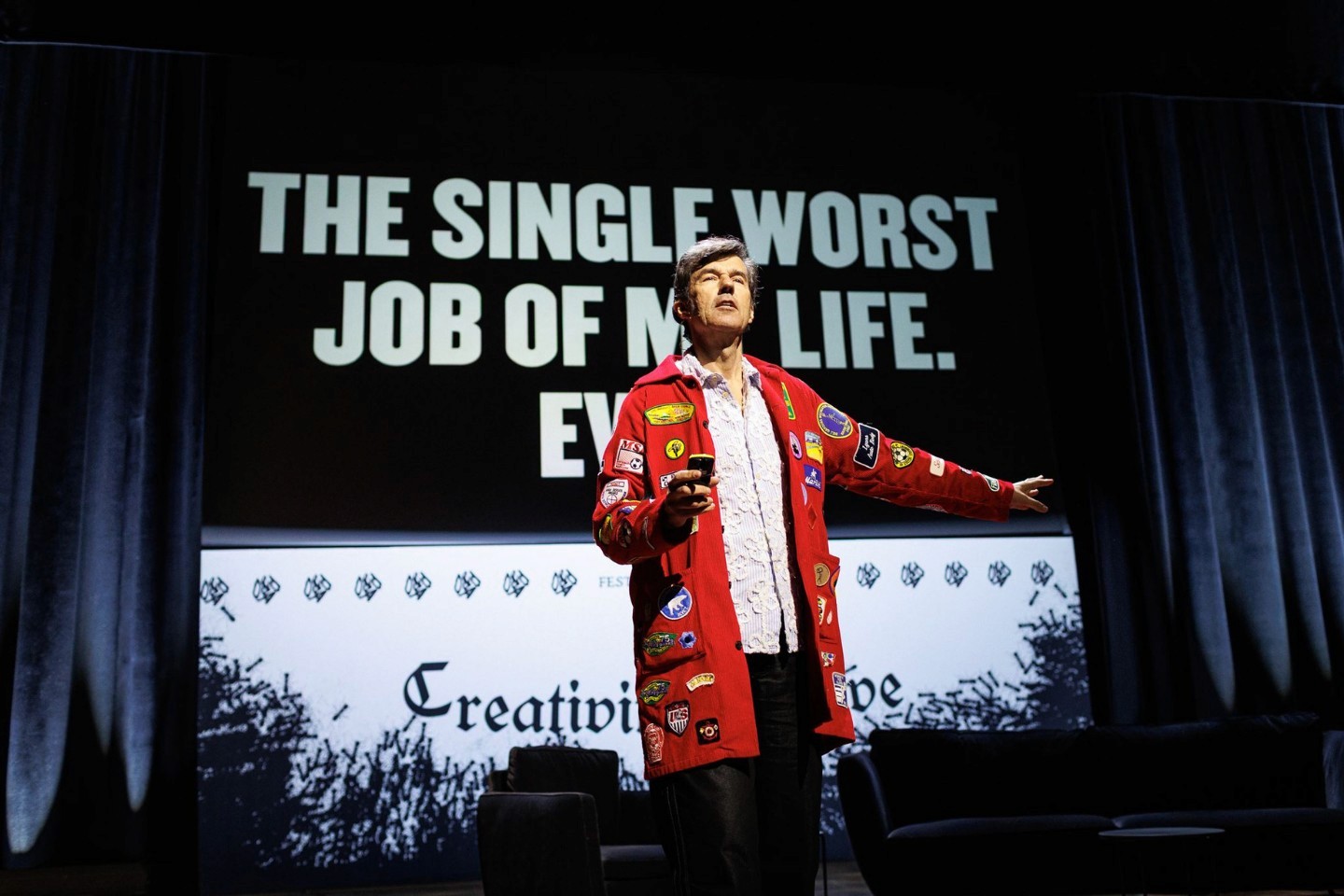
Stefan Sagmeister took to the stage with the following welcome: "Thanks for being here. You could be anywhere right now: you could be at home with AI, you could be coworking with Claude, but you chose to come here."
Our presence was rewarded with a journey through the design process of an analogue age, as Sagmeister shared the tale of his worst job ever: designing an Aerosmith album cover in the 1990s, complete with endless rounds of (analogue) edits, the threat of legal action, and a trip to India. After a day of talks about the ever-expanding crossover between design and technology, it was refreshing to revisit a different world of creativity - one that ran on rubber cement and craft knives, rather than Figma.
But it was a design event in 2026, so we couldn’t make it to the end without the topic of AI returning to the table. Asked for his view, Sagmeister took a predictably unimpressed stance, “With AI, people do the same crap they did five years ago, but now they do it faster and cheaper.” In other words, nobody cares if you can do something faster with AI; it doesn't take away from the human skill required to do it via the traditional route in the first place.
After that brief detour, he returned to his work and design in general, describing the ultimate end goal of his work as “a beautiful idea, well executed”. Echoing the views of Alex Center, who believes brands should help people, Sagmeister spoke of the importance of creative work that can both help and delight people, combining functionality and aesthetics. If you can create something that ticks both of those boxes, then it's work done well - and that seems like a pretty good point to end on.
Stefan Sagmeister took to the stage with the following welcome: "Thanks for being here. You could be anywhere right now: you could be at home with AI, you could be coworking with Claude, but you chose to come here."
Our presence was rewarded with a journey through the design process of an analogue age, as Sagmeister shared the tale of his worst job ever: designing an Aerosmith album cover in the 1990s, complete with endless rounds of (analogue) edits, the threat of legal action, and a trip to India. After a day of talks about the ever-expanding crossover between design and technology, it was refreshing to revisit a different world of creativity - one that ran on rubber cement and craft knives, rather than Figma.
But it was a design event in 2026, so we couldn’t make it to the end without the topic of AI returning to the table. Asked for his view, Sagmeister took a predictably unimpressed stance, “With AI, people do the same crap they did five years ago, but now they do it faster and cheaper.” In other words, nobody cares if you can do something faster with AI; it doesn't take away from the human skill required to do it via the traditional route in the first place.
After that brief detour, he returned to his work and design in general, describing the ultimate end goal of his work as “a beautiful idea, well executed”. Echoing the views of Alex Center, who believes brands should help people, Sagmeister spoke of the importance of creative work that can both help and delight people, combining functionality and aesthetics. If you can create something that ticks both of those boxes, then it's work done well - and that seems like a pretty good point to end on.
Stefan Sagmeister took to the stage with the following welcome: "Thanks for being here. You could be anywhere right now: you could be at home with AI, you could be coworking with Claude, but you chose to come here."
Our presence was rewarded with a journey through the design process of an analogue age, as Sagmeister shared the tale of his worst job ever: designing an Aerosmith album cover in the 1990s, complete with endless rounds of (analogue) edits, the threat of legal action, and a trip to India. After a day of talks about the ever-expanding crossover between design and technology, it was refreshing to revisit a different world of creativity - one that ran on rubber cement and craft knives, rather than Figma.
But it was a design event in 2026, so we couldn’t make it to the end without the topic of AI returning to the table. Asked for his view, Sagmeister took a predictably unimpressed stance, “With AI, people do the same crap they did five years ago, but now they do it faster and cheaper.” In other words, nobody cares if you can do something faster with AI; it doesn't take away from the human skill required to do it via the traditional route in the first place.
After that brief detour, he returned to his work and design in general, describing the ultimate end goal of his work as “a beautiful idea, well executed”. Echoing the views of Alex Center, who believes brands should help people, Sagmeister spoke of the importance of creative work that can both help and delight people, combining functionality and aesthetics. If you can create something that ticks both of those boxes, then it's work done well - and that seems like a pretty good point to end on.
" transform="translate(0 20)" width="997px"/></svg>)
Read more



Discuss your next project with us...
To learn more about what we can offer and how we can work together, we’d love to hear from you.
London
Accord Marketing,
1 Waterhouse Square, London EC1N 2ST.
South-West
The Node, 1 Enterprise Road,
Roundswell, Barnstaple,
Devon EX31 3YB.
All enquiries
020 7271 2481
Assume nothing.
Discuss your next project with us...
To learn more about what we can offer and how we can work together, we’d love to hear from you.
London
Accord Marketing,
1 Waterhouse Square, London EC1N 2ST.
South-West
The Node, 1 Enterprise Road,
Roundswell, Barnstaple,
Devon EX31 3YB.
All enquiries
020 7271 2481
Discuss your next project with us...
To learn more about what we can offer and how we can work together, we’d love to hear from you.
London
Accord Marketing,
1 Waterhouse Square, London EC1N 2ST
South-West
The Node, 1 Enterprise Road,
Roundswell Barnstaple,
Devon EX31 3YB
All enquiries
020 7271 2481